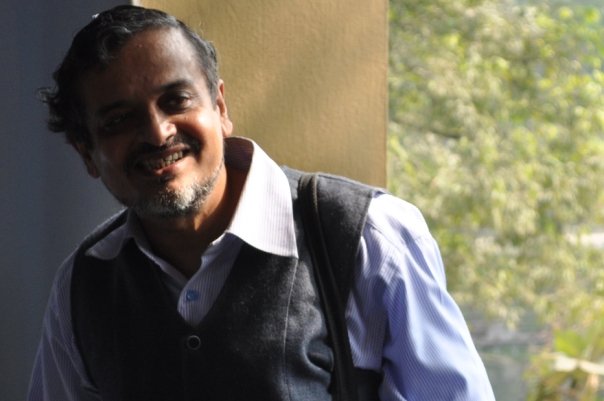
It’s been four years since Swapan-da left us. I was coordinating an event at the Currency Building (DAG’s Ghare Baire exhibition) when I received the text from a friend. The pandemic had taught us by then to expect the worst. I remember going with Kalpan for the cremation, where many friends had gathered. Last time we were there, Swapan-da had been cracking morbid jokes.
‘How much rent do you pay?’ he had asked. I said, ‘14k.’ Pointing to one of the houses bang opposite the Keoratala main gate, he asked, ‘Do you know how much rent these tenants pay? 5k.’ ‘I don’t think I’ll be able to bear the wailing, both of vehicles and human beings,’ I replied. He said, ‘That is how most people think. But my friend who lives here told me, “Swapan, you have gone far ahead in life. But in death, I’ll be a little closer to the finishing line.”’ I didn’t know what to say: we were there because someone we both knew had died. Nonetheless, he offered to drop me off at Victoria Memorial, where I was working at the time, on his way to the National Library.
When I was going to work the day after Swapan-da passed, a part of the Uber route coincided with the route we had taken on that previous occasion. I used to have my headphones on a lot of the time. It was too stressful to work at an intense pace through the pandemic and the CAA/NRC situation, without music to temporarily block out the sense of an ending—of the world as we knew it, at least. As the cab turned right onto Cathedral Road and the city got a little greener, Sahana Bajpaie’s rendition of D.L. Roy’s ‘Moloyo batashey’ started playing on Spotify.
বাষ্পের সনে আকাশে উঠিবো ,
বৃষ্টির সনে ধরায় লুটিবো
সিন্ধুর সনে সাগরে ছুটিবো
ঝঞ্ঝার সনে গাহিবো গান
[With the vapors I shall rise to the sky,
with the rain I shall fall upon the earth.
With the river I shall rush into the sea,
with the storm I shall sing a song.]
In that moment, the song became for me a lyric meditation on the dissolution of human lives. Not an ending, nor spiritual transcendence; perhaps more of a diffusion into gentler elements that appear universal.
For a brief moment after this emotional indulgence, I wondered if Swapan-da would be chuckling at my sentimentality. But probably not, I concluded upon further reflection. He did have a flippant way of speaking about a lot of things but that never meant that he took serious matters lightly. He remains one of the wisest people I have ever known—equally humble and kind.
Later, while reading Purano chaal, the posthumously published collection of essays, I realize how immediate my memory of Swapan-da still feels. His writing carries the vitality of the spoken word: while reading it, one feels his presence as poignantly as his absence. Makes me sad and happy in equal measure.
Although I have tried, in my way, to engage with the more accessible aspects of his vast scholarship, and to understand the positions and principles from which he worked in the wider world, I dare not offer my insights on Swapan-da in those capacities. I learnt a few very valuable things from him, often from throw-away remarks, and these I hold dear. Close friends and family tolerate my recollections of him with affection, so it is with them that I share these. It’s a strange, new feeling for me—to carry someone’s voice as such an active presence after they have gone, knowing full well that we cannot actually anticipate what they would have said or thought.

 Curiouser and Curiouser