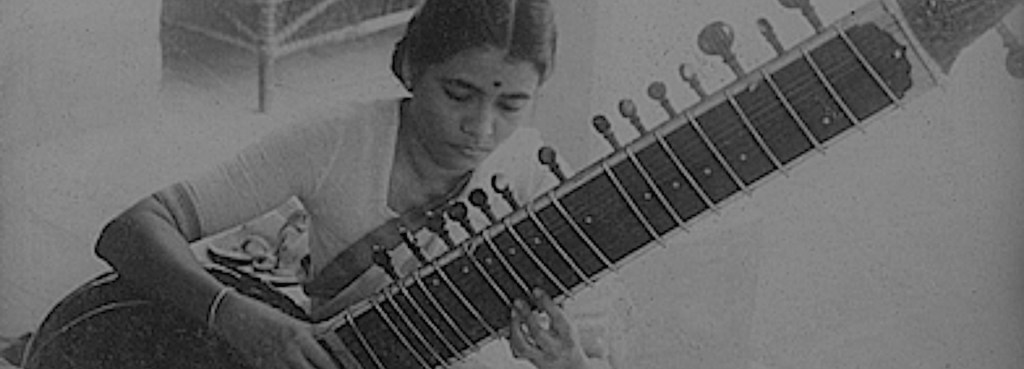
The Kolkata People’s Film Festival has led me to many powerful films over the years. Like the Book Fair, it’s become an essential part of my Kolkata calendar. On the last day of the 2025 edition, a friend and I happened to catch two remarkable films – Nirmal Chander’s 6-A Akash Ganga and Comrade Poopy, directed by Comrade M.
6-A Akash Ganga was Annapurna Devi’s address in Mumbai. Although I knew her father was Ustad Alauddin Khan, I wasn’t aware that she was born Roshanara Khan. She was re-christened by Maharaja Brijnath Singh of the Maihar estate later.
The film tries to tell her story through interviews with many of her students and a few acquaintances. At the centre is the absence of the artist herself, and the presence of her disciple, the flautist, Nityanand Haldipur. The post-screening conversation revealed that the film was made with the support of the Annapurna Devi Foundation, with the artist’s blessings. There was one basic condition attached to the blessing – that Haldipur “speak the truth.”
Haldipur and Chander make no bones about the fact the film represents Annapurna Devi’s perspective, although Ravi Shankar’s biographer Oliver Craske is invited for an in-person interview with the veteran flautist.
What struck me was that, despite granting permission to make the film, the artist never makes an appearance on screen, nor is the camera allowed inside her room. Fragments of conversation can be heard, but that voice is her only direct presence in the film. Annapurna Devi passed away in 2018, before the film’s completion. So, right at the end, after her passing, the camera does enter her room very tentatively.
Someone in the audience asked later if that was really necessary. I too wondered. Even as a member of the audience, it really felt like setting foot in some sacred space – almost like a garbhagriha. The camera pans across her bed and her belongings. Pictures of her parents and, on a shelf, a Christmas card with a cheerful Santa Claus. Chander said that it was that visual which convinced him to keep that shot – after all the intensity, it’s these things that mark us out as human beings.
Although I shared the discomfort with the gentleman in the audience, I came round to the view that it was a good idea, after all, to keep that scene. I am not sure it is what Annapurna Devi would have liked. But I wonder if it’s possible to be around people of her brilliance and severity and feel entirely comfortable about our own thoughts and actions. Even the few recordings that exist were supposedly made without her knowledge. Ultimately, I suppose it’s a question of the stakes of such an infringement. What is the value of what we salvage weighed against the transgression?
I am grateful for the little of her music that lingers in recorded form. As for the crossing the threshold of her room – I wonder what it does except satiate some voyeuristic curiosity. But as audience, the curiosity and the desire to respect someone’s wish can be equally potent; so, it cannot be said that the director fulfils the audience’s desire, on way or another. (Or he would end up fulfilling it either way.) But as a work of art, it perhaps makes sense to leave the audience with that sense of discomfort – if only to make us reflect on the nature of our sympathy with the film-maker and her disciple.
Comrade Poopy was very different and equally challenging. The short film follows a couple – Naw and her husband – as they make their way across vast jungles in the aftermath of the Myanmar military coup of 2021. Comrade M, however, chooses an unlikely protagonist to tell the tale – their ginger cat (looks a lot like the two I fostered), Comrade Poopy.
Surprisingly, Comrade M – who turned out to be quite funny – showed up on stage, a hat pulled down to his eyes and a mask up to his nose. He spoke with Dwaipayan Banerjee, one of the key people behind the KPFF, and answered questions quite candidly. When someone from the audience asked if the film had made an impact in Myanmar or, indeed, if it had been screened, Comrade M cheekily replied that as an artist, his work is to make films, even if it “doesn’t do shit” for on-ground politics. (There’s more to it than that, I guess? Someone must bear witness, after all. And stories of solidarity, even if they find no audience in the land of conflict itself, can bring hope in other parts of the world.)
The screenings were followed by a nice summer evening walk and drinks at Tripty’s.
(The featured image is from Wikipedia. Non-free image from The New York Times publication, dated 24 October 2018, from the Annapurna Devi archive.)

 Curiouser and Curiouser